🏞️ Rivers of the World
The great rivers of the world, from the Nile and the Amazon to famous shorter rivers such as the Rhine, Thames, Seine and Hudson, listed from longest to shortest. For each one: where it starts, where it ends, the countries it crosses, a photo, and the live weather and five-year weather history for the major cities along its banks. Rivers that end by joining another river can be traced all the way to the sea.
🗺️ River Map Tap a river for its course, cities and mouth
River colour shows where the water finally ends up. Imagery: Esri, Maxar, Earthstar Geographics. River lines are simplified and show the main named channel only; a few rivers without a line show an approximate dashed path through their cities.
📋 The Great Rivers Longest to shortest, with weather
Lengths are commonly cited approximations. Sources differ by hundreds of kilometres depending on where a river is said to start and how it is measured, so the order is approximate; a few entries are river systems (for example Mississippi–Missouri and Ob–Irtysh). Photos: Wikipedia and Wikimedia Commons. River lines: Natural Earth (public domain), simplified. Weather and history: Open-Meteo, five-year averages.
🌊 How Rivers Run
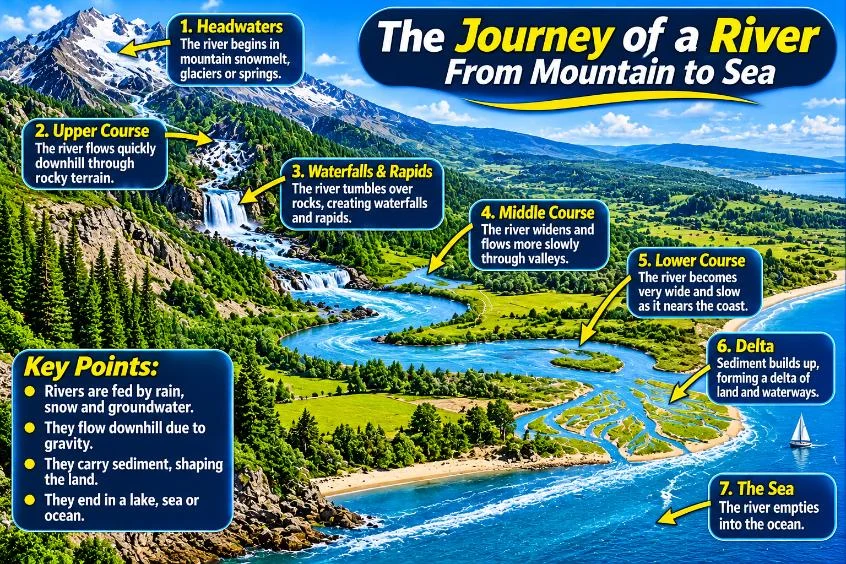
Every river is water moving downhill. It collects rain, melting snow and groundwater from the land around it, gathers into streams, and follows the lowest route it can find to a lake, a sea or the ocean.
Where these rivers end
🔺 Deltas
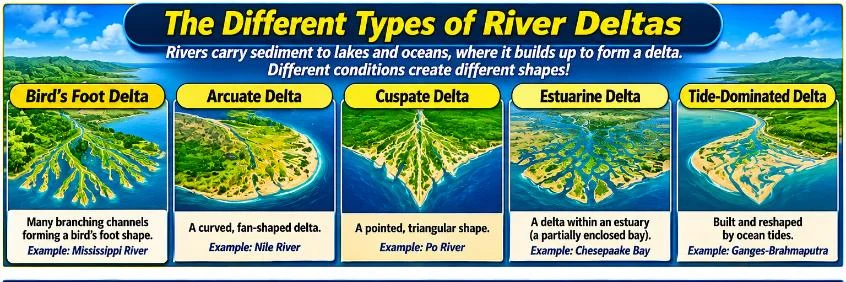
A delta forms where a river reaches still water, such as a sea or lake. The current slows, the river can no longer carry its load of sand and mud, and it drops the sediment, building new land that spreads into the water. The river splits into many branches called distributaries.
Rivers in this list that end in a delta
🧂 Where Fresh Water Meets Salt Water
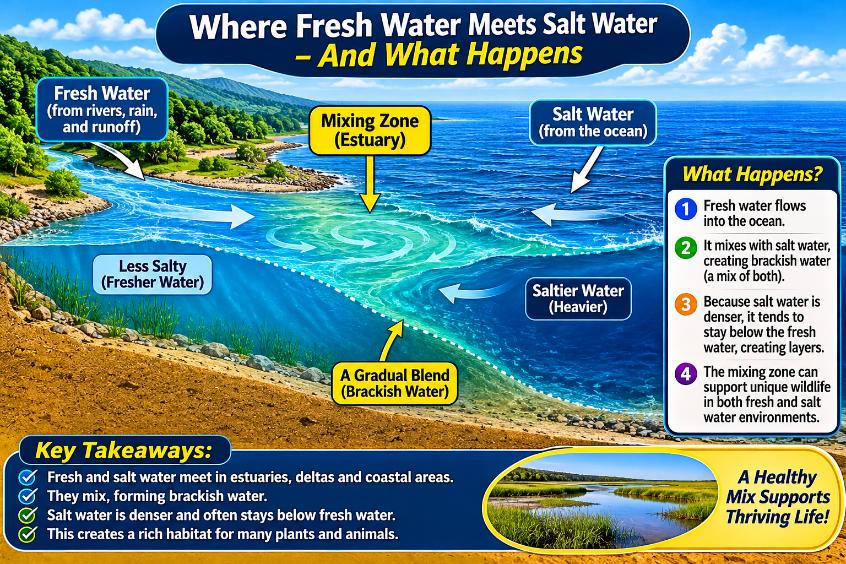
The place where a river meets the sea is called an estuary. Fresh water and salt water do not simply blend: salt water is denser, so the two push and slide past each other, shaped by the river's flow and the tide.
🗺️ Watersheds
A watershed (also called a drainage basin or catchment) is all the land that drains to one river and out through one outlet. Rain or snow that lands anywhere inside it will, over time, head toward the same river. The ridge line around the edge is the divide: raindrops landing on one side go one way and raindrops on the other side go another.
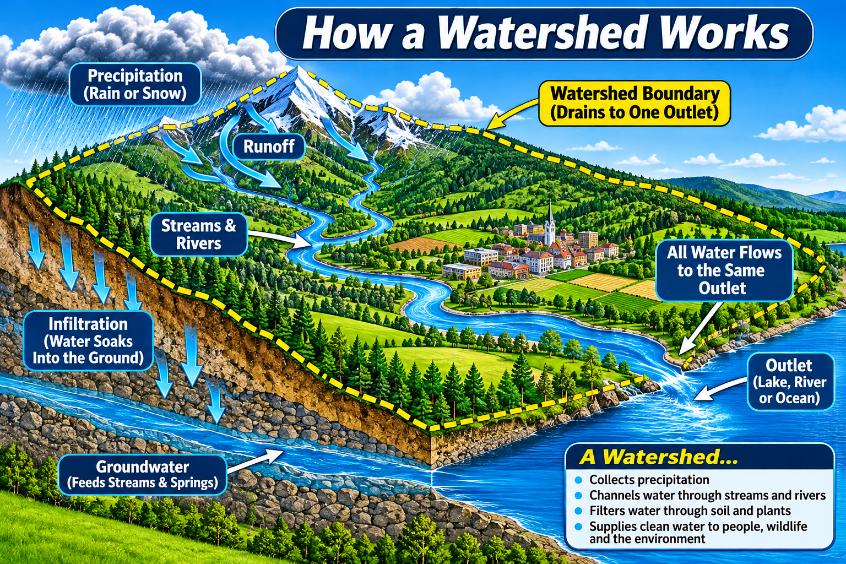
How a watershed works
- It is a catchment. Every point of land belongs to exactly one watershed at each scale.
- They nest. A creek's watershed sits inside a river's, which sits inside a bigger basin that drains to the ocean.
- The divide decides. A raindrop that lands a few metres either side of a ridge can end up in oceans thousands of kilometres apart.
- What happens upstream travels downstream. Fertiliser, sediment and pollution on the land are carried by the water, and so are the benefits of clean headwaters and healthy wetlands.
- Not all basins reach the sea. Roughly a fifth of the land drains to closed (endorheic) basins such as the Caspian Sea and the Great Basin, where water leaves only by evaporation.
Follow real raindrops from the mountains to the sea in Raindrop Journeys.
The largest river basins (approximate)
| River | Basin area | Drains to |
|---|---|---|
| Amazon | about 6–7 million km² | Atlantic Ocean |
| Congo | about 3.7 million km² | Atlantic Ocean |
| Nile | about 3.3 million km² | Mediterranean Sea |
| Mississippi–Missouri | about 3.2 million km² | Gulf of Mexico |
| Ob–Irtysh | about 3 million km² | Arctic Ocean (Kara Sea) |
| Paraná–La Plata | about 2.6 million km² | Atlantic Ocean |
| Yenisei | about 2.5 million km² | Arctic Ocean (Kara Sea) |
| Lena | about 2.5 million km² | Arctic Ocean (Laptev Sea) |
Basin areas vary by source and by what is counted; treat them as rounded estimates.
💧 Raindrop Journeys Follow the water from a point to the sea
Choose a journey to see the path a drop of water takes through a watershed. The route is drawn on the map above and explained step by step.
🏗️ Significant Dams 20 dams that changed rivers
A dam turns a river into a reservoir. The great dams hold back floods, store water for farms and cities, and make electricity. This is a set of 20 significant dams, picked for their size, power, height or history, from Hoover Dam to the Three Gorges Dam. Each has a photo, the facts, a place on the map and live weather at the dam.
Loading the map…
Heights, lengths, capacities and dates are taken from Wikipedia articles and differ a little between sources. Power is installed capacity in megawatts (MW). Weather is the current model estimate from Open-Meteo for each dam; use the units buttons in the river list above to switch between metric and US. Photos are from Wikimedia Commons under free licences; a few dams have no free photo yet.
⚡ Hydroelectric Power How a river becomes electricity
Hydroelectric power uses the energy of falling water. It supplies about 15% of the world’s electricity, almost 4,210 TWh in 2023, which is more than all other renewable sources combined and also more than nuclear power. Once a plant is built it burns no fuel, and a plant with a dam and reservoir can raise or lower its output in seconds or minutes to follow demand.
How it works
- Water is stored high up. A dam holds water in a reservoir above the powerhouse. The height of the fall is called the head.
- It flows down a pipe. Gates open and water rushes into an intake and down a large pipe called a penstock.
- It spins a turbine. The moving water hits the blades of a turbine and makes it turn.
- The turbine drives a generator. The spinning shaft turns magnets inside coils of wire, and that makes electricity.
- A transformer raises the voltage. Higher voltage lets the power travel far along transmission lines.
- The water carries on. It leaves through a channel called the tailrace and rejoins the river.
The power a plant makes depends on two things: how much water flows through it and how far the water falls. More of either means more power.
Five ways to make power from water
1. A dam and reservoir
Called impoundment. A dam stores water in a reservoir, and water is released through turbines when power is needed. Hoover Dam is a famous example. The output can be turned up or down in seconds or minutes, which makes it flexible.
2. Diversion and run-of-river
Little or no water is stored. Part of the river is turned aside through a canal, tunnel or pipe to a powerhouse and returned further down. A plant without a storage pond follows the river’s seasonal flow. Niagara works this way: water is taken from above the falls through tunnels and returned below them.
3. Pumped storage
A battery made of water. When power is cheap, water is pumped uphill to a high reservoir. When demand is high it is released through turbines. About 70 to 80% of the energy is recovered. Pumped storage made up almost 85% of the world’s 190 GW of grid energy storage in 2021. Dinorwig in Wales (1,800 MW) is a well-known example.
4. Tides
A tidal barrage works like a low dam across an estuary and uses the rising and falling sea. The Rance tidal power station in France (240 MW, opened in 1966) was the first of its kind. Tides are more predictable than wind or sun, but good sites are rare.
5. Small and micro hydro
A small turbine on a stream can power a farm, a village or a mountain hut. The first hydroelectric power scheme was built at Cragside, in Northumberland, England, in 1878, and in 1882 a plant on the Fox River in Appleton, Wisconsin, made about 12.5 kilowatts.
The turbines
Pelton wheel
An impulse turbine invented by the American Lester Allan Pelton in the 1870s. Fast jets of water hit buckets on a wheel, so it suits high mountain drops.
Francis turbine
The most common water turbine in use, named for James B. Francis, who designed it in 1848. Water flows inward through the runner, and it can be more than 95% efficient.
Kaplan turbine
A propeller turbine with adjustable blades, developed in 1913 by the Austrian professor Viktor Kaplan. It works well where the water has a low drop but a lot of flow.
The hydropower story in numbers
1936 to 2008
Hoover Dam’s 1,345 MW station was the world’s largest in 1936. Grand Coulee (6,809 MW) passed it in 1942. Itaipu (14 GW) opened in 1984, and the Three Gorges Dam (22.5 GW) passed it in 2008.
Who relies on it
Some countries, including Norway, the Democratic Republic of the Congo and Paraguay, get over 85% of their electricity from hydropower. China added 24 GW of hydropower capacity in 2022, nearly three quarters of the world’s additions.
The good and the bad
- Good: low-carbon power on demand, flood control, irrigation and drinking water, and navigation.
- Costs: farmland lost and people moved, changes to river life and silt, and methane and carbon from flooded forest in the tropics.
- Risk: a dam failure can be catastrophic, as at Vajont in 1963.
Hydropower vistas
Some of the most striking places to see hydropower are beside Niagara Falls, where two huge plants sit on either side of the border.
🌉 Niagara Falls Power and Nikola Tesla The power station that proved alternating current
Niagara Falls is famed for its beauty and is also a valuable source of hydroelectric power. In the 1890s the falls became the place where engineers showed that alternating current could carry a river’s power over long distances, and the generators were built on the ideas of Nikola Tesla.
The Niagara Falls Hydraulic Power & Manufacturing Company becomes the first company to generate hydroelectric power from the falls.
George Westinghouse licenses Tesla’s polyphase induction motor and transformer designs, paying $60,000 in cash and stock plus a royalty of $2.50 for each horsepower of AC power produced.
The Edward Dean Adams Power Plant goes into operation, the first large-scale alternating-current generating plant in the world. Westinghouse builds its 5,000-horsepower, 25-hertz AC generators, based on the work of Nikola Tesla and others.
Transformers raise the voltage from 2,000 volts for use at the falls to 10,000 volts for nearby areas and 20,000 volts for Buffalo, Lockport and Tonawanda.
Ontario builds the Sir Adam Beck stations, which today have a capacity of 1,962 MW.
The Robert Moses Niagara Power Plant opens (2,525 MW today), and the old Adams plant closes after 66 years.
Why Tesla matters here
Nikola Tesla was born on 10 July 1856 in Smiljan, then part of the Austrian Empire and now in Croatia, and he died in New York City in January 1943. He is known for his work on the modern alternating-current (AC) electricity supply system.
AC is useful because transformers can raise its voltage for long-distance transmission, and Tesla’s polyphase system made efficient AC motors and generators possible. That is what a power station at a waterfall needed, because the customers were far away.
In 1960 the international body for weights and measures named the unit of magnetic flux density the tesla in his honour. A statue of Tesla stands in Niagara Falls State Park.
Niagara today: in summer at least 2,800 m³/s still passes over the falls, about 90% of it over Horseshoe Falls, while the rest is diverted through the power plants. The 1950 Niagara River Treaty regulates the diversions. A treaty in 1909 had already limited them to about 1,600 m³/s.